Data routing examples
This document gives more detailed information about the data routing within the BITMOTECO Platform.
Introduction
All modules use encapsulated containers for their data processing. Because our product enforces a high security and abstraction level (virtual) network connections are the only enabled way to communicate between those containers. In the default environment each container can only communicate with other containers of the same module and the host system.
Examples
The following examples shows the communication between containers for different use cases. The focus of this chapter is on the connections between the individual containers. For an easier understanding of the network connections the concept of modules and their access restrictions are neglected.
MQTT Sensor integration
Any sensor or device that supports the MQTT protocol can be connected to the BITMOTECOsystem. The port 1883 allows unencrypted connections to the internal MQTT broker if the correct username and password combination is provided.
For a safer connection one can use the additional Transport Layer Security (TLS) protocol by using the port 8883. In this case the sensor or client device needs a valid certificate for this broker and all communication between the client and the broker is encrypted.

IO-Link Sensor integration
Sensors which support the IO-Link protocol are supported by using an external IO-Link Master with MQTT support. The IO-Link Master forwards the received sensor values as MQTT messages. The available security and encryption capabilities for the MQTT connections depend on the used MQTT Master device.

LoRaWAN Sensor integration
In order to receive measurements from wireless sensors which transmit their values by using the LoRaWAN protocol stack the help of external devices is needed. This can be either a public LoRaWAN receiver network (e.g. The Things Network (TTN)) or at least one local LoRaWAN gateway. Since all LoRaWAN gateways receive the encrypted messages from all sending devices within their range, a downstream LoRaWAN server that filters, decrypts and forwards the massages is needed.
Using public receiver networks
Usually public receiver networks host and provide all necessary services to process the received LoRaWAN messages in combination with a web user interface. Which this interface customers can provide their device IDs along with the corresponding encryption keys and set a target to forward the messages to. For this task encrypted MQTT messages are a common way to receive the measured values on a local device.
Using local gateway
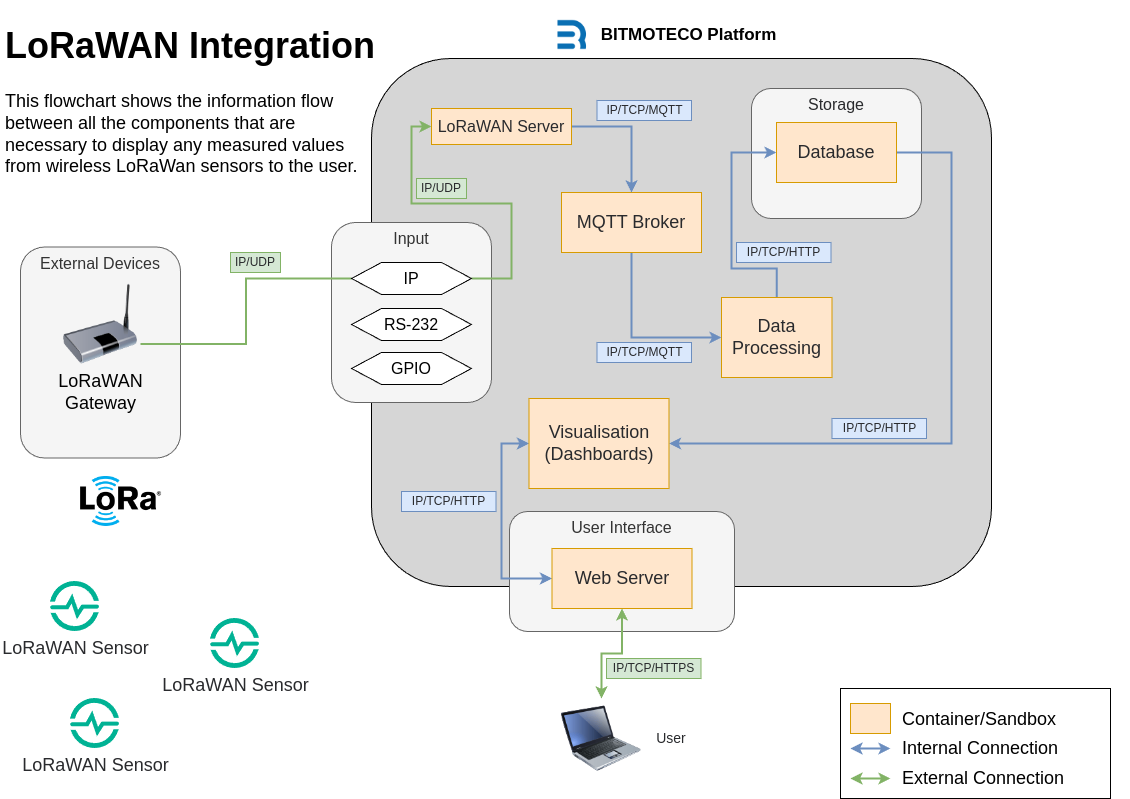
When using a local LoRaWAN gateway all received encrypted messages are forwarded to the BITMOTECOsystem using a simple UDP connection. A LoRaWAN server, which supports the full LoRaWAN protocol stack, processes each message and is responsible for filtering and decryption the received messages. Thus a customer must enter the device IDs and corresponding encryption keys into the Bitmoteco Platform web user interface in order to forward the messages to the internal MQTT broker.